Our group started off our amazing day (even though it was raining) with a presentation on the Jesuits in Rome by Reed. During his presentation we walked to Il Gesu church and St. Ignazio church. We then listened to Lia’s presentation on Obelisks, visiting Minerveo, Macutco and Solare Obelisks around Rome. Everyone ended their day with a walking tour with Tyler Landsford on Latin inscriptions in Rome.
The rain stopped when we met at the Rome Center and walked to Il Gesu church. Reed is sick so he had to use his “small voice” while talking to us outside the church on Victor Emanuel street. Il Gesu, dedicated to Jesus, is the mother church of the Jesuits and marks the beginning of Baroque style architecture. Cardinal Alexander Farnese, the grandson of Pope Paul III, commissioned this church. It is dedicated to Jesus and one of the first things I noticed about the façade was the big “IHS” that is inscribed in the front of the church. “IHS” is Christ’s name in Greek and all the Jesuit churches show this lettering throughout all the churches. On the façade, on either side of the door, you see two sculptures. On the Right hand side is the depiction of religion stomping out heresy and the one on the left hand side is the triumph of the church over heresy.
The illusionist ceiling catches the eye of every person that walks into Il Gesu. This ceiling is the “triumph of the name of God” and there is a mirror placed perfectly in the back of the church so that visitors can look up at the ceiling and see the full effect of the figures in the painting “falling out” of the painting. The Jesuit community wanted a less grand, wooden ceiling while Farnese wanted a fancy, vaulted ceiling and since he was commissioner, he was able to complete the ceiling the way he wanted. The Jesuits believed art was for education and didn’t believe in lavish decorations. Il Gesu, is a high renaissance church that is beautifully decorated but not to Jesuits normal simple taste. So we must assume that all the grand decorations were added over time and by the patron himself.
 We saw the two most famous side chapels of Il Gesu, Chapel of St. Ignatius and St. Francis Xavier. The chapel of St. Ignatius holds his tomb and is very extravagant, to the point that he wouldn’t have agreed with the grandeur style of his tomb. Directly across from that chapel is the tomb of St. Francis with a relic of his arm (symbolizing his missionary work of converting many people), this chapel is way more understated and less eye catching.
Reed told us that Jesuits are a secular clergy, meaning they adopt the dress and language of the region and culture they are preaching in. After the Counter Reformation, the soul purpose of Jesuit churches was to be able to see and hear the preacher while having good acoustics. This changed the architecture of Il Gesu in that it is shorter and wider than most churches and has side chapels so that more than one mass could be preformed at once. There are a couple of predominate depictions that occur in most Jesuit churches which are the letters “IHS” are written through the church, the scene of the circumcision of Jesus is usually on the high alter and the depiction of missionary work.
After the Il Gesu we followed Reed to St. Ignazio church. It was surprising to see that the fronts of Il Gesu and St. Ignazio were almost identical, with the only differences being there were no statues. The ceiling inside this church was typical for the 17th century and was less extravagant than Il Gesu, but still had the illusionist look. It depicted the four continents that Christianity had reached; Asia, Africa, Europe and America. The main feature that caught the group’s eye was the dark “dome” that is really just a painting. Before the church was finished they ran out of money and so they couldn’t complete a dome so the artist just painted an illusion of a dome.
Right after Reeds presentation we walk to Piazza della Minerva to hear Lia’s presentation on obelisks. We were lucky to see three of the thirteen obelisks in Rome. Originating in Egypt, they were built for celebratory and religious purposes, are usually made of one stone, having four square sides that taper to the top and were moved when Egypt fell to Rome. Pope Sixtus brought back obelisks and made a path for the pilgrims so that from each one you can see another.
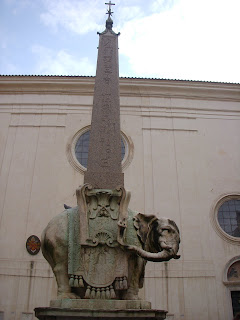
The first obelisk we saw was Minerveo in Piazza della Minerva. It is the smallest obelisks standing at 5 ½ meters, made out of red granite and was placed here in 1667. This obelisk is one of a twin set that was made in Egypt in sixth century. The base was designed by Bernini and on top of the base is a human size elephant. On the elephant’s forehead are the words zeal and industry. The next obelisk we went to was Macuteo in Piazza della Rotonda (Pantheon). Here we talked mainly about the other thirteen obelisks in Rome. An interesting fact that Lia told us is the obelisk Vaticano in St. Peter’s Square is one of two not inscribed on. Our next obelisk we saw was Solare/Campense in Piazza di Montecritorio. It is 72 feet tall and was brought back by Caesar to symbolize conquer over Egypt. At the very end of her presentation it started to rain hard, Lia quickly rapped up her presentation and all rain for cover!
After our lunch break we met back up for our walking tour with Tyler Landsford. The weather was holding up for us, and we were all excited to hear about the latin inscriptions throughout Rome. We started in Paizza della Cancelleria, then moved to the far side of the Campo, then to Capo di Ferro, then Ponte Sisto, to Largo de Librari, into the Ghetto, and then through the Ghetto to Tiber island. We followed the path of the old Via della Pellegrino. My favorite inscriptions that we saw were the ones on top of eight statues on the façade of Palazzo Spada. The eight statues are of Trajan, Gnaeus Pompey the Great, Fabius Maximus, Romulus, Numa, Marcus Marcellus, Dictator Caesar and Augustus Caesar. Trajan’s really stands out to me, reading “Trajan, an emperor of invincible valor, deserved the name of ‘Best.’”
The rain stopped when we met at the Rome Center and walked to Il Gesu church. Reed is sick so he had to use his “small voice” while talking to us outside the church on Victor Emanuel street. Il Gesu, dedicated to Jesus, is the mother church of the Jesuits and marks the beginning of Baroque style architecture. Cardinal Alexander Farnese, the grandson of Pope Paul III, commissioned this church. It is dedicated to Jesus and one of the first things I noticed about the façade was the big “IHS” that is inscribed in the front of the church. “IHS” is Christ’s name in Greek and all the Jesuit churches show this lettering throughout all the churches. On the façade,
 on either side of the door, you see two sculptures. On the Right hand side is the depiction of religion stomping out heresy and the one on the left hand side is the triumph of the church over heresy.
The illusionist ceiling catches the eye of every person that walks into Il Gesu. This ceiling is the “triumph of the name of God” and there is a mirror placed perfectly in the back of the church so that visitors can look up at the ceiling and see the full effect of the figures in the painting “falling out” of the painting. The Jesuit community wanted a less grand, wooden ceiling while Farnese wanted a fancy, vaulted ceiling and since he was commissioner, he was able to complete the ceiling the way he wanted. The Jesuits believed art was for education and didn’t believe in lavish decorations. Il Gesu, is a high renaissance church that is beautifully decorated but not to Jesuits normal simple taste. So we must assume that all the grand decorations were added over time and by the patron himself.
 We saw the two most famous side chapels of Il Gesu, Chapel of St. Ignatius and St. Francis Xavier. The chapel of St. Ignatius holds his tomb and is very extravagant, to the point that he wouldn’t have agreed with the grandeur style of his tomb. Directly across from that chapel is the tomb of St. Francis with a relic of his arm (symbolizing his missionary work of converting many people), this chapel is way more understated and less eye catching.
Reed told us that Jesuits are a secular clergy, meaning they adopt the dress and language of the region and culture they are preaching in. After the Counter Reformation, the soul purpose of Jesuit churches was to be able to see and hear the preacher while having good acoustics. This changed the architecture of Il Gesu in that it is shorter and wider than most churches and has side chapels so that more than one mass could be preformed at once. There are a couple of predominate depictions that occur in most Jesuit churches which are the letters “IHS” are written through the church, the scene of the circumcision of Jesus is usually on the high alter and the depiction of missionary work.
After the Il Gesu we followed Reed to St. Ignazio church. It was surprising to see that the fronts of Il Gesu and St. Ignazio were almost identical, with the only differences being there were no statues. The ceiling inside this church was typical for the 17th century and was less extravagant than Il Gesu, but still had the illusionist look. It depicted the four continents that Christianity had reached; Asia, Africa, Europe and America. The main feature that caught the group’s eye was the dark “dome” that is really just a painting. Before the church was finished they ran out of money and so they couldn’t complete a dome so the artist just painted an illusion of a dome.
Right after Reeds presentation we walk to Piazza della Minerva to hear Lia’s presentation on obelisks. We were lucky to see three of the thirteen obelisks in Rome. Originating in Egypt, they were built for celebratory and religious purposes, are usually made of one stone, having four square sides that taper to the top and were moved when Egypt fell to Rome. Pope Sixtus brought back obelisks and made a path for the pilgrims so that from each one you can see another.

The first obelisk we saw was Minerveo in Piazza della Minerva. It is the smallest obelisks standing at 5 ½ meters, made out of red granite and was placed here in 1667. This obelisk is one of a twin set that was made in Egypt in sixth century. The base was designed by Bernini and on top of the base is a human size elephant. On the elephant’s forehead are the words zeal and industry. The next obelisk we went to was Macuteo in Piazza della Rotonda (Pantheon). Here we talked mainly about the other thirteen obelisks in Rome. An interesting fact that Lia told us is the obelisk Vaticano in St. Peter’s Square is one of two not inscribed on. Our next obelisk we saw was Solare/Campense in Piazza di Montecritorio. It is 72 feet tall and was brought back by Caesar to symbolize conquer over Egypt. At the very end of her presentation it started to rain hard, Lia quickly rapped up her presentation and all rain for cover!
After our lunch break we met back up for our walking tour with Tyler Landsford. The weather was holding up for us, and we were all excited to hear about the latin inscriptions throughout Rome. We started in Paizza della Cancelleria, then moved to the far side of the Campo, then to Capo di Ferro, then Ponte Sisto, to Largo de Librari, into the Ghetto, and then through the Ghetto to Tiber island. We followed the path of the old Via della Pellegrino. My favorite inscriptions that we saw were the ones on top of eight statues on the façade of Palazzo Spada. The eight statues are of Trajan, Gnaeus Pompey the Great, Fabius Maximus, Romulus, Numa, Marcus Marcellus, Dictator Caesar and Augustus Caesar. Trajan’s really stands out to me, reading “Trajan, an emperor of invincible valor, deserved the name of ‘Best.’”
After listening to Tyler’s translations of the inscriptions, I couldn’t stop thinking about the amount of dedication that he put into his work. Stacie asked him about the process he went to find inscriptions, especially the inscription on Ponte Rotto. For this particular inscription he read about it in a book, then every time he visited Rome he would come to this bridge and look for this inscription until finally he found it one day. His lecture was so interesting and walking around the city, being able to see exactly what he was translating was an incredible experience.


